Last updated: 10 November 2026
A B2B SaaS team is ready for RevOps help when its pipeline numbers are disputed, leads fall between marketing and sales, and nobody can explain why the forecast missed. If those are true, RevOps consulting for B2B SaaS is likely to pay back. The ten signs below each say whether a consultancy, a hire or both fits better.
Equanax sells RevOps and CRM consulting, so we have said for each sign whether a consultancy, an internal hire or both fits better, and flagged where a hire is the right answer. For evaluating firms once you have decided, see our guide to the best RevOps consultancies for B2B SaaS.
The ten signs
For each sign you will find the symptom you see, the cause underneath and the cost of leaving it. The last line says whether it points to a consultancy or an internal hire.
1. Pipeline numbers are disputed between teams
Symptom: sales, marketing and finance quote different figures for the same pipeline. Cause: no shared definitions of stages or sources. Cost if ignored: meetings spent arguing about numbers rather than acting on them. Fit: a consultancy can agree the definitions and build them into the CRM.
2. Leads fall between marketing and sales
Symptom: marketing says it passed leads over, and sales says it never saw them. Cause: unclear handoff rules and routing. Cost: slow follow-up and wasted spend. Fit: a consultancy for the build, then an owner for the rules.
3. Reporting depends on spreadsheets
Symptom: the weekly report is built by hand from exports. Cause: data that is not structured for reporting, or tools that are not connected. Cost: hours every week and numbers that go stale. Fit: a consultancy to design the data and reports.
4. Stage definitions differ by rep
Symptom: two reps put similar deals at different stages. Cause: no written exit criteria. Cost: a pipeline that cannot be compared or trusted. Fit: a consultancy to write them and build validation into the CRM, with sales leadership enforcing them, as our guide to CRM data quality describes.
5. Forecast misses are hard to explain
Symptom: the number moves late and nobody can say why. Cause: dated close dates, stale deals and inconsistent method. Cost: loss of trust from the board. Fit: a consultancy to fix the inputs, then a hire to run the cadence.
6. CRM fields are blank or inconsistent
Symptom: key fields are empty and the same value is written several ways. Cause: optional entry and no validation. Cost: broken segmentation, routing and scoring. Fit: a consultancy for rules and automation, then an owner to keep them current.
7. Tools are added but not connected
Symptom: a new tool every quarter, each holding its own copy of customers. Cause: no owner for the stack. Cost: duplicated work and conflicting records. Fit: a hire, with a consultancy for integration work.
8. Renewals surprise the team
Symptom: accounts churn or downgrade with little warning. Cause: signals from product, support and billing do not reach account owners. Cost: lost revenue that was often visible in the data. Fit: a consultancy to connect the data, with customer success owning the signals.
9. Nobody owns the CRM end to end
Symptom: changes are made by whoever needs one, and nobody can say who is responsible. Cause: no operations function. Cost: drift, and every project slows down. Fit: a hire.
10. Hiring is planned before process is fixed
Symptom: the plan is to add reps or SDRs to fix a revenue gap. Cause: a belief that more capacity solves a process problem. Cost: new hires inherit and multiply the mess. Fit: a consultancy first, then hire.

Consultancy, hire or both

A consultancy suits a defined, finite problem. A hire suits ongoing ownership. If the problem is ongoing but you also need a system built, do both: a fixed-scope project to build it, then a hire to own it. Our guide to RevOps partners for UK SaaS scaleups names firms to consider, and our HubSpot consulting for B2B SaaS growth page describes how we work.
A self-assessment
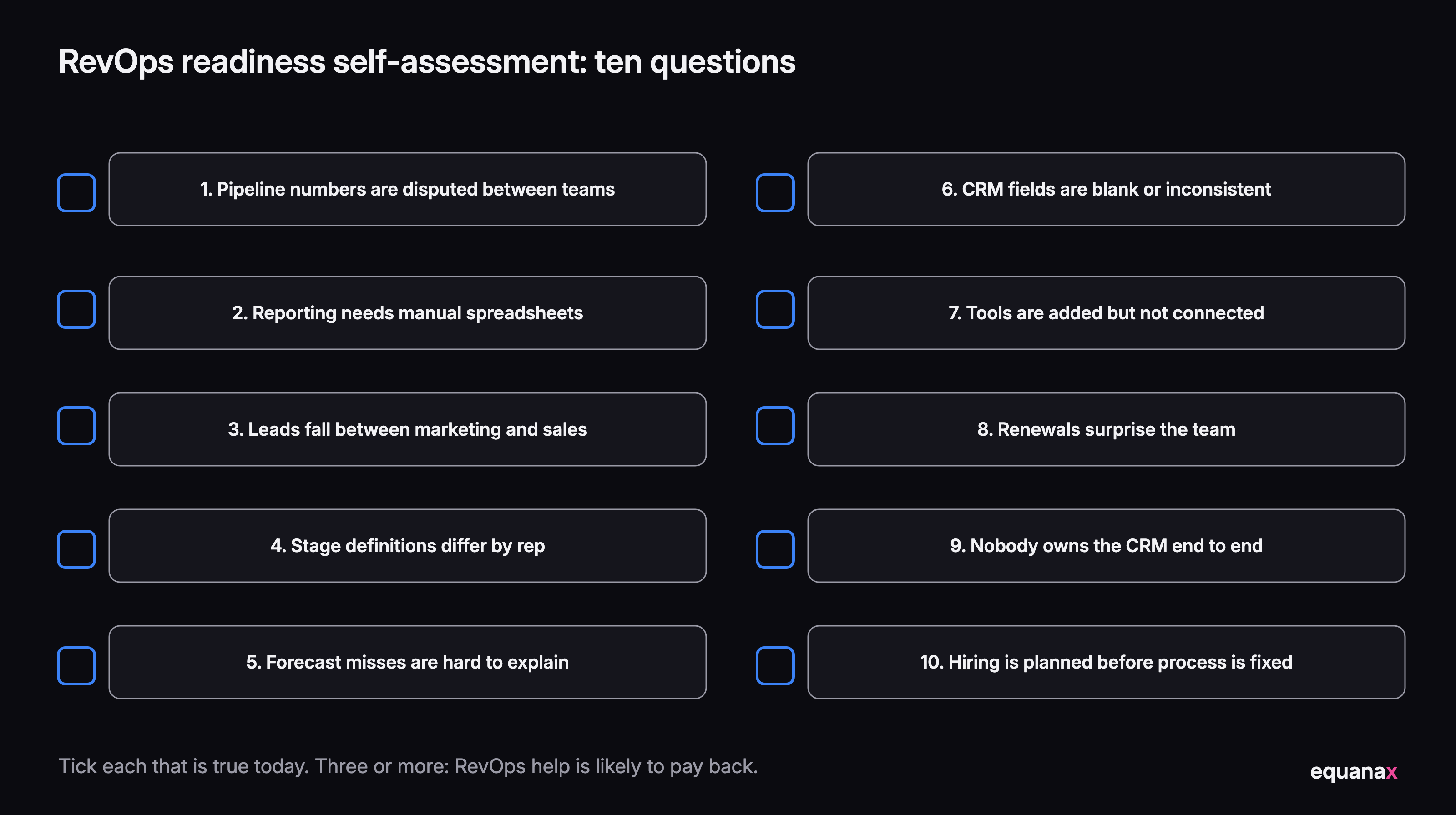
Tick each statement that is true today: pipeline numbers are disputed, reporting needs spreadsheets, leads fall between teams, stage definitions differ by rep, forecast misses are hard to explain, fields are blank or inconsistent, tools are not connected, renewals surprise the team, nobody owns the CRM, and hiring is planned before process is fixed. Three or more ticks means the cost of waiting is probably higher than the cost of acting. Eight or more suggests the problem is structural, and a short audit is the sensible first step.
What the signs have in common
Read back over the ten signs and a pattern appears. Most come from the same root: the business grew faster than its operating system. Definitions, ownership and data structures that worked at ten people stop working at fifty, and the symptoms show up in different places depending on who is looking. Sales sees disputed numbers, marketing sees leaking leads and finance sees a forecast it cannot reconcile, but the cause is shared.
That is why one well-scoped piece of work often resolves several signs at once. Agreed stage definitions with exit criteria address signs one, four and five together. A single data model and the routing built on it address two, three and six. This is also why it is worth resisting the temptation to buy a tool for each symptom: tools applied to unclear definitions multiply the problem.
When it is too early
Sometimes the answer is not yet. A team of two or three sellers with a simple product and a handful of deals can often manage with a clearly written one-page process and a tidy CRM. RevOps help pays off when complexity has arrived: more than one team touching the pipeline, more than one product or segment, or more than one system holding customer data.
If you are unsure, a short audit is a low-cost way to find out. It will tell you whether you have the problem, how big it is and what the first piece of work should be, before you commit to a project.
What to do in the first 30 days
Once you decide to act, resist the urge to start with tools. In the first week, write down the three problems you most want solved and the measure that would show each was solved. In the second, take a baseline of those measures. In the third, agree stage definitions and the owner of each object. In the fourth, decide whether you need a consultancy, a hire or both, and write the brief. Our RevOps ROI guide shows how to turn the measures into a return calculation.
FAQ
How do B2B SaaS companies know when to hire a RevOps consultancy?
Usually when several of these are true: pipeline numbers are disputed, leads fall between teams, reporting needs manual spreadsheets, stage definitions differ by rep or forecast misses are hard to explain. Three or more suggest a consultancy is likely to pay back. If nobody owns the CRM end to end, plan an internal hire as well.
How do B2B SaaS companies evaluate RevOps agencies before hiring one?
They score agencies on stated criteria such as platform fit, process design, automation, data depth, commercial clarity, references and handover, check references with specific questions and compare written scopes. Our guide to the best RevOps consultancies for B2B SaaS lists the criteria, red flags and reference questions.
Should we hire a RevOps person or a consultancy first?
If you have a defined problem to solve, such as a stage redesign or a migration, start with a consultancy and plan for an owner afterwards. If the work is ongoing and you have nobody who owns the CRM, hire first or at the same time. Hiring before the process is fixed risks inheriting the mess.
How long does it take to see results from RevOps help?
Admin time and reporting effort can improve within weeks of new rules and automation. Cycle time and forecast reliability usually need a full sales cycle or forecasting period, and win rate and churn take longest. Record a baseline before you start so that you can show what changed.
Is a RevOps consultancy worth it for a small SaaS team?
It can be, if the problem is defined and the team lacks capacity or experience to solve it. Smaller teams often benefit most from a short, fixed-scope project to set definitions and build core rules, followed by light-touch ownership. Avoid open-ended retainers until you know what ongoing work you need.
About the author
Jack Crabtree is Director of Equanax. He has built on HubSpot, Salesforce, n8n, Clay and Apollo, and has delivered more than 100 automation workflows for revenue teams. To check your own readiness, book a free AI audit.
Leave a Reply