Last updated: 10 November 2026
B2B SaaS teams evaluate RevOps consultancies by scoring them on seven criteria, checking references and watching for a short list of red flags, and they know it is time to hire when pipeline numbers are disputed, handoffs leak leads and reporting needs manual effort. The consultancies below, which have a UK office and describe RevOps or CRM and revenue systems work on their own sites, are Six & Flow, Huble, Mo Agency, Blend B2B, Arise GTM, SpotDev, Evara and Equanax.
Equanax is the author of this guide. This one is about the buyer's process, so we say how to evaluate before we name anyone, and every claim about another firm comes from that firm's own website, mainly the page we link.
When to hire a RevOps consultancy
The signs are practical rather than numerical. Pipeline figures are disputed between teams. Leads fall between marketing and sales. Reporting depends on spreadsheets. Stage definitions differ by rep, and forecast misses are hard to explain. Tools have been added without being connected, and no one owns the CRM end to end.
If three or more of these are true, outside help will usually pay back, especially if you have no internal RevOps lead. Our guide to the signs your SaaS team is ready for RevOps help lists ten, with the cause behind each and whether a consultancy or a hire fits best.
Selection criteria: how we chose
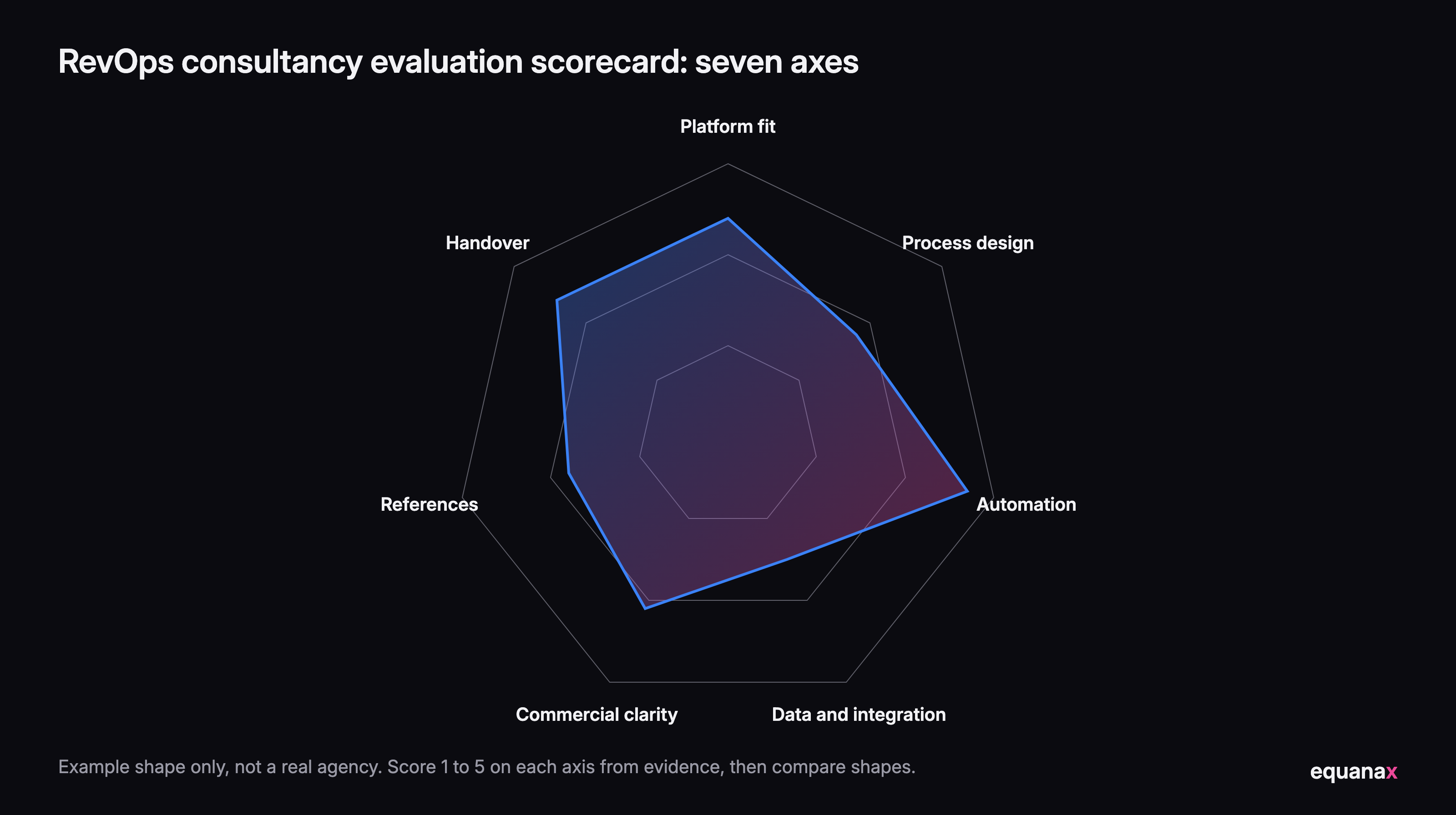
We included firms with a UK office whose own sites describe RevOps, revenue operations or CRM and revenue systems work, and compared them on seven criteria, which are also the criteria we suggest you use on any shortlist:
- Platform fit. Does the firm work in the platform you run?
- Process design. Does it design stages, ownership and reporting, or only build what it is told?
- Automation. Does it build automation and integrations?
- Data and integration depth. Can it connect billing, product and support data?
- Commercial clarity. Is the model, whether fixed fee, retainer or subscription, stated?
- References. Can it offer a like-for-like reference?
- Handover. Is documentation and handover a named deliverable?

Comparison table
| Agency | Best for | Relevant service stated | Commercial model | UK office | Question to ask first | Source |
|---|---|---|---|---|---|---|
| Six & Flow | B2B and software teams | RevOps consulting and sales enablement | Not published | Manchester, London | Can you show a forecasting example? | https://www.sixandflow.com |
| Huble | Large, multi-region programmes | Revenue operations and sales process design | Not published | London | What does a typical first engagement include? | https://www.huble.com |
| Mo Agency | Fintech, healthcare, SaaS | CRM and RevOps | Not published | London (headquartered in South Africa) | Which sector case studies match ours? | https://www.mo.agency |
| Blend B2B | PE-backed and mid-market B2B | Sales process, CPQ and RevOps | Not published | Reading | How is CPQ work scoped? | https://www.blendb2b.com |
| Arise GTM | B2B SaaS and fintech | GTM strategy, RevOps and managed AI agents | Published on its own site | London | What do the monthly tiers include? | https://arisegtm.com/hubspot-agency |
| SpotDev | Teams on HubSpot needing engineering | Managed RevOps retainers and engineering subscription | Fixed price where scope allows | Bath | What does a managed RevOps retainer include? | https://www.spotdev.co.uk/contact |
| Evara | Financial services firms | CRM and growth systems, AI and automation | Fixed-scope, priced after a workshop | London | Does your experience transfer outside finance? | https://www.evara.co |
| Equanax | B2B SaaS and financial services | RevOps build with five revenue agents | Fixed fee, work starts on payment | Sutton, London | What happens after handover? | https://equanax.com/ |
Red flags and green flags

The red flags that matter most: a fixed date and price quoted before discovery, no written exclusions, references only from unlike clients, dashboards promised before the data is fixed, no handover in scope, and an inability to say what the firm would not do. The green flags are their opposites: questions about your data and definitions first, exclusions named in writing, a like-for-like reference, documentation as a deliverable, a candid account of a past problem, and a willingness to say what belongs with an in-house hire.
Reference-call questions
A reference is only useful if you ask better questions than "were you happy". Ask:
- What were you trying to change, and how did you measure it?
- What did the consultancy get wrong, and how fast did it put it right?
- Did the people who sold the work deliver it?
- How accurate was the first estimate against what happened?
- Could your team run the system afterwards, without them?
- What would you do differently if you hired them again?
Listen for specifics. A reference that can describe a rule, an integration or a report in detail has used the work. One that can only describe the relationship has not.
Six & Flow: RevOps with enablement
Six & Flow suits B2B and software teams that want RevOps and sales enablement from one partner. Its site lists RevOps consulting and sales enablement, HubSpot implementation and optimisation, data consulting and AI consulting. It has offices in Manchester and London.
Huble: RevOps for large programmes
Huble suits larger organisations. Its site lists revenue operations and sales process design among CRM implementation, migration and integration services, and it has a London office. It positions itself for mid-market and enterprise work.
Mo Agency: CRM and RevOps
Mo Agency suits teams in fintech, healthcare, SaaS and manufacturing. It is headquartered in South Africa and has a London office. Its site lists CRM and RevOps alongside HubSpot implementation, migration, audit and demand generation.
Blend B2B: sales process and CPQ
Blend B2B suits PE-backed and mid-market B2B companies on HubSpot. Its site lists sales process, CPQ and RevOps, alongside onboarding, integrations, managed services and marketing, and states Diamond partner status. Its UK office is in Reading.
Arise GTM: RevOps with managed agents
Arise GTM suits B2B SaaS and fintech teams. Its HubSpot agency page lists GTM strategy, ABM, RevOps and product marketing, plus portal audits and migrations. It is based in London and publishes its pricing, including managed monthly tiers.
SpotDev: RevOps engineering
SpotDev suits teams on HubSpot that need engineering capacity. Its contact page points to managed RevOps retainers and an engineering subscription. It quotes fixed prices where scope allows and is based in Bath.
Evara: CRM and growth systems
Evara (formerly Inbound FinTech) suits financial services firms wanting platform-agnostic work. Its site lists HubSpot services, Salesforce consulting and AI and automation, with fixed-scope projects and managed services. It is London based.
Equanax: fixed-fee RevOps with agents
Equanax suits B2B SaaS and financial services teams that want RevOps built, automated and handed over for a fixed fee. This is us, so weigh it accordingly. Equanax is based in Sutton and London and works across HubSpot, Salesforce, n8n, Clay and Apollo.
We design stages, routing and reporting and build our five revenue agents: Research, Qualify, Deal Reviving, CRM Updating and Signal Intelligence. Work is a fixed fee with no retainer, and starts on payment. A team that wants ongoing managed RevOps should look at firms that sell retainers. See our HubSpot consulting for B2B SaaS growth page, and for the full shortlist method our guide to RevOps partners for UK SaaS scaleups.
A four-week evaluation plan
A structured process stops you choosing on the best presentation. In week one, write down the problem you want solved in a paragraph, name the two or three measures that would show it was solved and agree the criteria weights with the people who will use the system. In week two, hold first calls with your shortlist, asking each the same questions in the same order, and collect written scopes with exclusions. In week three, speak to references. In week four, score independently, compare, and negotiate scope, handover and change-request terms with your preferred firm before you sign.
Keep the group small and the decision owner clear. Evaluations with too many voices tend to select the most agreeable firm instead of the most suitable one.
What to do if you cannot decide
If two firms score closely, run a small paid first step with each, such as a short audit of your CRM, and compare what you receive. A diagnostic reveals how a firm thinks, how clearly it writes and how it handles your data, at low cost and low risk. If the audit is not useful, you have learned that cheaply.
If neither is right, widen the shortlist, or consider whether the real need is a hire. A consultancy is a poor substitute for an owner, and a poor owner is a poor substitute for a decision about what the function is for.
Consultancy, hire or both
A consultancy suits a defined, finite problem, such as designing stages and reporting, building the automation or migrating a CRM. An in-house hire suits ongoing ownership of the function. Many B2B SaaS teams do both in sequence: a fixed-scope project builds the system and documents it, then a hire inherits it with a runbook rather than an agency relationship. If you cannot name an owner for the system after the project, plan for that before you buy.
A retainer suits ongoing work where you want outside capacity. It is less suited to standing in for a hiring decision, because the knowledge stays outside your business. Whichever route you choose, ask what you will own at the end.
How to score and decide
Score each firm from 1 to 5 on each criterion, after reference calls rather than after the sales demonstration. Ask someone outside the buying team to score independently, then compare. A large disagreement is worth understanding before you sign. Weight the criteria to your situation: if you have no RevOps lead, weight process design and handover highest, and if you have heavy billing and product data, weight integration depth. Then compare written scopes, not headline prices, and check what you own at the end. Our RevOps ROI guide shows how to measure the result.
FAQ
How do B2B SaaS companies evaluate RevOps agencies before hiring one?
They score each agency against stated criteria, such as platform fit, process design, automation, data depth, commercial clarity, references and handover. They check references with specific questions, ask for written scopes with exclusions, and watch for red flags such as a fixed price before discovery. Scoring after reference calls works best.
How do B2B SaaS companies know when to hire a RevOps consultancy?
Usually when pipeline numbers are disputed, leads fall between teams, reporting needs manual spreadsheets, stage definitions differ by rep and nobody owns the CRM end to end. Three or more of those signs suggest outside help will pay back, particularly without an internal RevOps lead.
What are the red flags when hiring a RevOps consultancy?
A fixed date and price quoted before discovery, no written exclusions, references only from unlike clients, dashboards promised before the data is fixed, no handover in scope, and an inability to say what the firm would not do. Any one is a prompt for questions rather than a verdict.
What should I ask a RevOps consultancy's references?
Ask what they were trying to change and how they measured it, what the consultancy got wrong and how fast it fixed it, whether the sellers delivered the work, how accurate the first estimate was, and whether the team could run the system afterwards. Listen for specifics rather than general praise.
Should we hire a RevOps consultancy or an in-house RevOps manager?
A consultancy suits a defined, finite problem, and a hire suits ongoing ownership. Many teams do both: a fixed-scope project to build the system, followed by a hire to own it. Our guide to the signs your team is ready for RevOps help includes a decision flow.
About the author
Jack Crabtree is Director of Equanax. He has built on HubSpot, Salesforce, n8n, Clay and Apollo, and has delivered more than 100 automation workflows for revenue teams. To talk through your own shortlist, book a free AI audit.
Leave a Reply