Last updated: 10 November 2026
UK B2B SaaS companies improve CRM data quality and pipeline hygiene by giving every object a named owner, writing standards for what each field and stage means, enforcing them with required fields and automation, and reviewing exceptions on a fixed weekly and monthly cadence. This guide is the operating manual: the model, the rules, the automation and a 30, 60 and 90 day plan to put it in place.
Equanax is the author of this guide and sells CRM consulting, so we have kept the method usable without us. If you decide you want help, our comparison of the best UK CRM consultants for SaaS data quality lists the options, including firms other than us.
Why SaaS CRMs rot
CRM data degrades in predictable ways. Five causes recur in B2B SaaS:
- Nobody owns it. Fields are added by whoever needed one, and no one is responsible for the whole.
- Definitions drift. Two reps use the same stage to mean different things, so reports compare unlike deals.
- Entry is manual and optional. If a field is not required, it is skipped under time pressure, and the gaps are never fixed.
- Sources multiply. Forms, imports, integrations and enrichment tools all write records, and duplicates follow.
- There is no feedback. Nobody sees the cost of bad data, so nobody changes behaviour.
The fixes below map onto these causes. Ownership answers the first, standards the second, controls the third, dedupe the fourth and reporting the fifth.
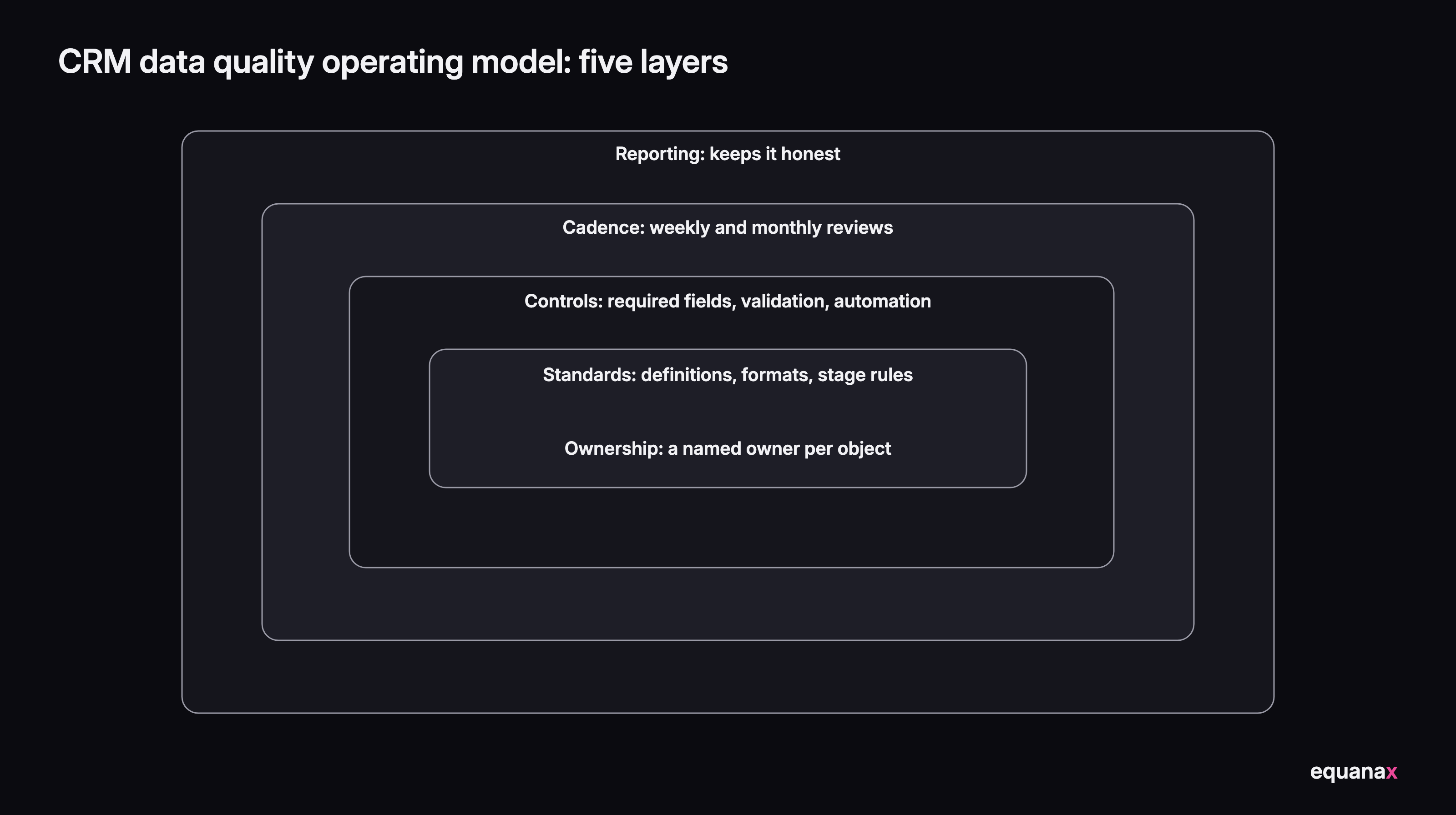
The data quality operating model

Ownership. Name one owner for each object: contacts, companies, deals and any custom objects. The owner does not do all the work. They decide the standard and arbitrate disputes.
Standards. Write down what each field means, its format, who may change it and when it is required. Write down what each pipeline stage means. A one-page standard per object is enough.
Controls. Turn the standard into rules the system enforces: required fields, dropdowns in place of free text, validation and automation that fills or flags gaps.
Cadence. Set a rhythm for review: a short weekly exceptions check and a monthly look at trends and duplicates.
Reporting. Publish a small number of data quality measures, such as the share of open deals with a close date and next step, so that quality is visible to the people who create it.
Required fields by object and lifecycle stage
Required fields should be few and tied to the moment they become useful. Asking for everything at creation produces junk, because people fill fields with whatever lets them proceed.
- Contacts: email, owner, lead source and lifecycle stage at creation. Job role once known, and the lawful basis for marketing before you first email them.
- Companies: domain, owner, country and size band at creation. Industry and segment before the first qualified meeting.
- Deals: owner, amount, close date and primary contact at creation. A next step with a date once the deal passes discovery.
- Custom objects: the identifier from the source system, so records can be matched and updated rather than duplicated.
Build the rules into stage progression, not into a general form. A deal that cannot move to proposal without an amount and a decision-maker is cleaner than one that is nagged about it afterwards.
Pipeline hygiene rules reps will follow
Rules survive when they are few, clear and visibly useful. Three do most of the work.

Stage exit criteria. Each stage has two or three observable conditions, such as "need confirmed and decision-maker identified" for a qualified deal. They are facts that can be checked, not feelings.
Close-date discipline. A close date is the date by which the buyer expects to decide, not the date you hope for. Any deal whose close date has passed is flagged for the owner until it is moved or closed.
A stale-deal policy. Define how long a deal may sit without activity at each stage. When it exceeds the limit, the owner confirms next steps, moves it back or closes it lost. Closing a dead deal honestly is better than carrying it.
Deduplication and enrichment
Duplicates come from forms, imports and integrations. Prevent them at the point of entry where you can: match on email for contacts and domain for companies, and decide in advance which record survives a merge and which field wins when values conflict.
For existing duplicates, merge in batches and review a sample each time before merging the rest. Merges are hard to reverse, so agree the matching rules first. HubSpot includes duplicate management on some paid subscriptions, and tools such as Clay and Apollo can enrich missing fields from public and licensed sources. Whichever you use, record the source and date of an enriched value, so you can tell later where a number came from.
Automation that enforces hygiene without nagging

The aim is to make the right thing the easy thing. A trigger fires when a record is created or changed. A check compares it against your rules. Where the system can fill a gap, for example by enriching a company's size band, it does. Where it cannot, it flags the record to its owner with a clear instruction. A weekly report lists what remains.
The failure mode is nagging: a flood of alerts that people learn to ignore. Keep alerts specific and rare, send them to the owner rather than a channel, and group them into a weekly digest unless the issue is urgent.
Equanax's CRM Updating agent is one way to automate part of this. It reads emails, calls and meetings and proposes updates to fields and stages, with each change logged and risky changes held for review. Whether you use an agent, native HubSpot workflows or n8n, the design principle is the same: the system keeps the record true and a person handles the exceptions. See our AI sales agents page for how agents are governed.
The weekly and monthly hygiene review
The weekly review takes fifteen minutes. Each manager looks at their team's exceptions list: deals past their close date, deals missing a next step, and records flagged by the automation. Owners fix or close each one before the forecast call.
The monthly review looks at trends. Are duplicates rising? Which fields are most often blank? Which rule is most often overridden, and is the rule wrong? Treat a rule that everyone overrides as evidence the rule needs changing, not the people.
This is also where data quality connects to forecasting. A forecast built on clean stages and close dates is more credible, as our guide to how revenue operations improves SaaS forecasting explains.
A 30, 60 and 90 day plan

Days 1 to 30: audit, owners, standards. Audit what is blank, duplicated and inconsistent, by object. Name the owners. Write the one-page standard for each object and the stage definitions.
Days 31 to 60: required fields, dedupe, stage rules. Build required fields into stage progression. Merge the worst duplicates in reviewed batches. Introduce stage exit criteria and close-date rules.
Days 61 to 90: automation, reporting, review cadence. Add the hygiene automation, publish the small set of quality measures and start the weekly and monthly reviews.
Each phase ends with something you can check: a list, a rule set, a report. If a phase has no checkable output, it has not finished.
Data quality and UK GDPR
Data quality is also a compliance matter. UK GDPR expects personal data to be accurate and, where necessary, kept up to date, and not held longer than needed. In a CRM that means correcting wrong contact details, removing records you have no reason to keep, and recording the lawful basis you rely on for each contact, including where consent came from if consent is that basis. Build these into the standard rather than treating them as a separate project: a retention rule for stale contacts, a field that records the lawful basis and, where you rely on consent, its source and date, and a routine for handling access and deletion requests.
None of this replaces advice from your own legal adviser, but a CRM with clear ownership, written standards and a record of who changed what makes it much easier to answer questions about what you hold and why.
What to measure
Measure a handful of things and publish them where the people who enter data can see them. A good starter set is the share of open deals with a close date in the future, the share with a dated next step, the share of contacts with an owner and a lifecycle stage, the number of suspected duplicate pairs, and the share of records created by each source that fail a required-field check.
Do not set targets before you have a baseline. Record the starting position in the first month, then agree targets with the owners. Report each measure by team, not by individual, so the conversation is about the process. If a measure never moves, ask whether the rule behind it is practical, or whether the people it applies to have a reason to ignore it.
Common mistakes
Four mistakes recur in data quality programmes. The first is cleaning without controls: a one-off clean-up that is undone within a quarter because nothing changed at the point of entry. The second is demanding too much data at creation, which produces plausible nonsense in required fields. The third is treating data quality as an IT task, when the people who create the data are the only ones who can keep it true. The fourth is automating before standardising: automation applies your rules faster, so if the rules are unclear it spreads the confusion faster too.
A useful discipline is to write the rule in plain English first, check that two different people would apply it the same way, and only then build it. If two people would disagree, the rule is not ready to be automated.
When to bring in a consultancy
You can run this yourself if you have a RevOps or sales operations lead with time to own it. A consultancy helps when you lack that owner, when your data model needs redesign rather than cleaning, or when you want automation built quickly. Judge consultancies on whether they have a governance method, whether they automate enforcement and whether they leave you able to run the system without them. Our guide to the best UK CRM consultants for SaaS data quality applies those tests, and our guide to the best CRM consulting firms for B2B SaaS covers the wider market. Our service page on HubSpot consulting for B2B SaaS growth describes how we work.
FAQ
How can UK B2B SaaS companies improve CRM data quality and pipeline hygiene?
Name an owner for each object, write standards for fields and stages, enforce them with required fields and automation, merge duplicates in reviewed batches, and run a weekly exceptions review and a monthly trend review. Publish a few quality measures so people see the effect of their entries. Sequence the work over 90 days: audit and standards first, then required fields and dedupe, then automation and reporting.
Which CRM consulting firm should UK B2B SaaS companies choose?
Choose one that has a governance method, automates enforcement and leaves you able to run the system yourself. Our comparison of UK CRM consultants for SaaS data quality applies those tests to a named list that includes Equanax. Ask each firm for a worked example and a reference from a similar SaaS business.
What fields should be required in a SaaS CRM?
Require few fields, tied to when they become useful. For deals, require owner, amount, close date and primary contact at creation, and a dated next step after discovery. For companies, require domain, owner, country and size band at creation. Build the requirements into stage progression rather than a single long form.
How do we stop duplicate records in HubSpot?
Prevent duplicates at entry by matching on email for contacts and domain for companies, and decide in advance which record survives a merge. Merge existing duplicates in reviewed batches, because merges are hard to reverse. Use native duplicate management and record the source of enriched values so you can trace them later.
How often should we review CRM data quality?
Weekly and monthly. A fifteen-minute weekly review has each manager clear their team's exceptions, such as deals past their close date or missing a next step. A monthly review looks at trends, such as rising duplicates or fields often left blank, and at rules that are regularly overridden.
About the author
Jack Crabtree is Director of Equanax. He has built on HubSpot, Salesforce, n8n, Clay and Apollo, and has delivered more than 100 automation workflows for revenue teams. If you would like a review of your own CRM data, book a free AI audit.
Leave a Reply