Last updated: 10 November 2026
Revenue operations improves SaaS forecasting by owning the inputs: the definitions of each stage, the hygiene of the data in the CRM, the method used to turn deals into a number, and the weekly rhythm in which the number is reviewed. Forecast accuracy is mostly a data discipline problem, and revenue operations is the function that owns that discipline.
This is a short, practical companion to our RevOps ROI guide. Equanax is the author, and sells RevOps and CRM work, so treat our suggestions as a method to test rather than a promise of results.
Why SaaS forecasts miss
Five causes account for most misses, and none of them is a lack of dashboards:
- Stages mean different things to different reps. A deal at proposal for one rep is a hope for another.
- Close dates are aspirational. They record when the rep wants the deal, not when the buyer will decide.
- Stale deals stay open. Dead deals inflate pipeline and hide the real number.
- Data is incomplete. Missing amounts, owners or next steps make any method unreliable.
- The method is inconsistent. The number is sometimes weighted, sometimes judgement, and nobody can say which.
Each of these is an input problem. A better model applied to bad inputs gives a more elaborate wrong answer.
The RevOps forecasting stack

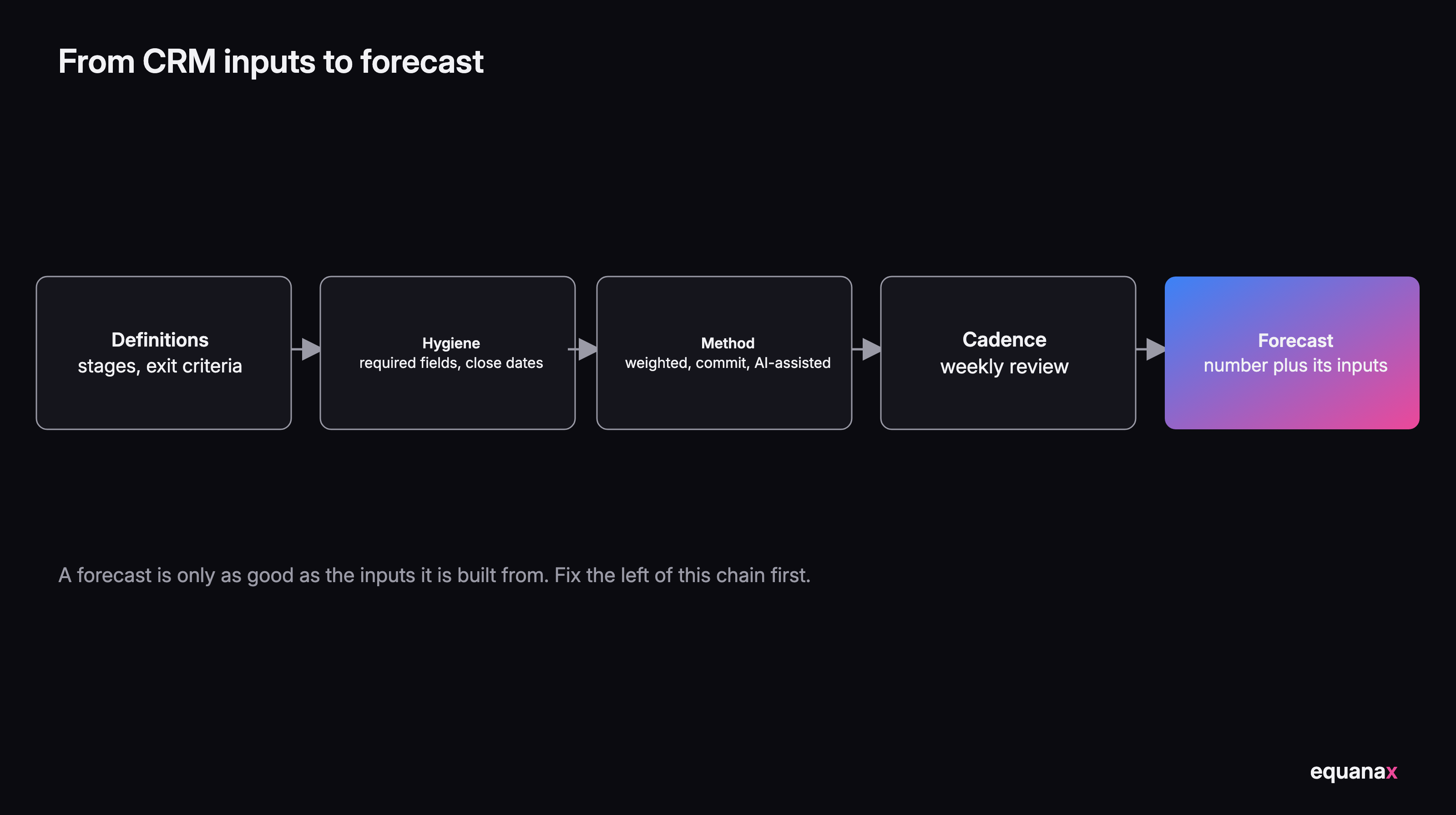
Definitions. Write a stage definition and exit criteria for every stage. Exit criteria are facts that can be checked, such as "buyer and process mapped", not opinions.
Hygiene. Enforce required fields at each stage, flag deals past their close date, and set a stale-deal rule. Our CRM data quality guide covers the operating model in detail.
Method. Choose how pipeline becomes a number and apply it the same way every week.
Cadence. Review on a fixed rhythm, so movement in the number is visible and explained.
Tooling. Use the CRM's forecast tools, or a dedicated one, only once the first four are in place.
Weighted, commit and AI-assisted methods compared
A weighted forecast multiplies each deal's value by the probability attached to its stage. It is simple and transparent, but it is only as good as the stage probabilities, and those should come from your own conversion history, not defaults. A commit forecast asks owners to call the deals they are confident of closing, usually with a manager's review. It captures judgement but is open to optimism and sandbagging. An AI-assisted forecast uses a model trained on past deals and activity to estimate the outcome of each deal. It can spot patterns people miss, but needs enough clean history to learn from and needs to be explained to the people who rely on it.
Many teams run weighted and commit side by side and treat a large gap between them as a prompt for a conversation. Whatever you choose, record which method produced each number, so you can compare accuracy over time.
What to automate
Automate the inputs, not the judgement. Useful automations flag deals past their close date, prompt for a missing next step, propose field updates from emails, calls and meetings, and produce the weekly exceptions list. Equanax's CRM Updating agent is one way to do the update step: it proposes field and stage changes from emails, calls and meetings, logs each one and holds risky changes for review. The principle holds for any tool: keep the record current with as little manual effort as possible, and let people spend their time on the deals.
A weekly forecast review cadence

Start the week with an automated hygiene report. Give owners until midweek to fix flagged deals. Hold the manager review of committed deals, then the forecast call, and lock the number. The consistency matters more than the exact days. Keep a short written log of each week's changes to the number and the reason for each, because the log is what turns a forecast from an opinion into something you can learn from. After a quarter, the log shows which kinds of deal slip, which reps are consistently optimistic or cautious, and which stages hold deals longest, and that is the evidence you need to adjust the stage probabilities and the rules.
How to start: a four-week plan
You do not need a project to begin. In the first week, write stage definitions and exit criteria with your sales leaders, and agree them in one sitting. In the second, build the hygiene rules into the CRM: required fields at each stage, a flag for passed close dates and a stale-deal limit. In the third, choose your forecasting method and record the stage probabilities from your own conversion history. In the fourth, run the first full weekly cadence and review what the exceptions list shows.
Expect the first cycle to be uncomfortable. The exceptions list will be long, because it is the first time anyone has seen the gap between what the CRM says and what is true. That is the point. The list shrinks as owners fix records and the rules become habit, and the forecast becomes easier to explain as it does.
How to measure whether it is working
Track forecast accuracy, but also track the inputs that drive it. Compare each week's committed number with what actually closed, and note the direction and size of the miss. Alongside that, track the share of open deals with a future close date and a dated next step, the number of deals flagged as stale, and the time managers spend preparing for the forecast call.
If the inputs improve and accuracy does not, look at the method and the probabilities. If accuracy improves but only because people sandbag, look at the incentives. Revenue operations can set up the measures, but leadership has to agree to act on what they show. Record a baseline before you change anything, so that you can say later what the work changed and what would have happened anyway.
Where this fits in a RevOps engagement
Forecasting work is usually one part of a wider RevOps engagement, sequenced after the data model and stage definitions. If you are weighing up help, our guide to the best CRM consulting firms for B2B SaaS sets out the options, and our HubSpot consulting for B2B SaaS growth page explains how we work.
FAQ
How should B2B SaaS assess the ROI of a RevOps automation agency?
Record a baseline before the work starts, agree which two or three measures will decide success, such as forecast reconciliation time or cycle time, and measure the same things afterwards. Count only benefits you can trace to the work. Our RevOps ROI guide includes a free spreadsheet template for this.
What are the benefits of revenue operations for scaling UK B2B SaaS businesses?
Revenue operations gives sales, marketing and customer success one set of definitions and one source of numbers. For a scaling business that typically means a more reliable forecast, less manual reporting, cleaner handoffs between teams and a CRM that can take new products and hires without a rebuild. Measure each against a baseline.
Why do SaaS forecasts miss?
Mostly because of inputs: stages that mean different things to different reps, close dates that are hopes rather than decisions, stale deals left open, missing data and an inconsistent method. Fixing definitions, hygiene and cadence usually does more for accuracy than changing the forecasting tool.
Is weighted or commit forecasting better?
Neither is better in general. Weighted forecasting is transparent and consistent if the probabilities come from your own history. Commit forecasting captures judgement but can be optimistic. Many teams run both and treat a large gap as a prompt for discussion, and record which method produced each number.
Can AI improve a SaaS forecast?
It can help if you have enough clean history for a model to learn from, because it can find patterns in deals and activity that people miss. It does not fix poor inputs. Treat it as one view alongside a weighted or commit forecast, and make sure the people who rely on it understand how it works.
About the author
Jack Crabtree is Director of Equanax. He has built on HubSpot, Salesforce, n8n, Clay and Apollo, and has delivered more than 100 automation workflows for revenue teams. To talk about your own forecast process, book a free AI audit.
Leave a Reply