Last updated: 10 November 2026
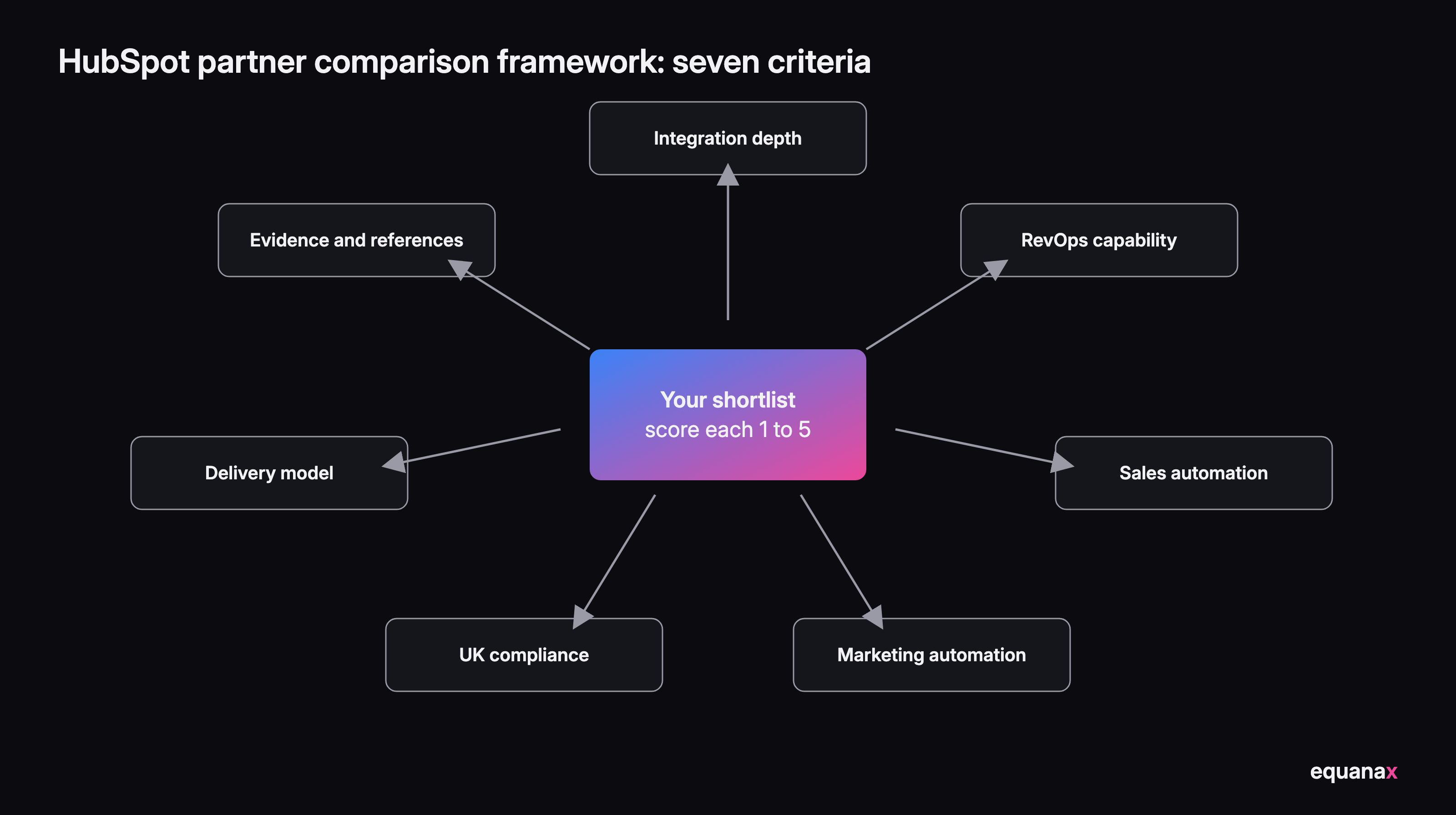
When comparing HubSpot implementation partners, UK B2B SaaS teams should score each on seven things: integration depth, RevOps capability, sales automation, marketing automation, UK compliance, delivery model and evidence from references. The partner tier is a filter, not a verdict, and the most useful test is whether the partner can describe, with an example, how your product, billing and support data would land in HubSpot.
Equanax is the author of this guide and is one of the partners you could compare, so we have kept the framework independent of us. It is written to be used on any shortlist, ours included. A named UK shortlist built on the same framework is in our guide to the best UK HubSpot implementation partners for SaaS.
What a HubSpot partner tier does and does not tell you
HubSpot groups Solutions Partners into tiers. Above the entry level, they run upward from Gold through Platinum and Diamond to Elite. A tier reflects HubSpot's own partner programme criteria. It is a useful signal that an agency has delivered at some scale, and a reasonable way to shorten a long list.
It does not tell you whether the agency has integrated a billing system like yours, whether it designs process or only configures software, or whether the people who sold you the project will be the ones who deliver it. Treat the tier as a way to start the conversation and confirm it on the HubSpot directory rather than relying on a homepage badge.
The comparison framework: seven criteria

Below, each criterion comes with a way to test it in a sales call. The tests are deliberately practical: they ask for a worked example, because a description of capability is easy to give and an example is not.
1. Integration depth
SaaS implementations succeed or fail on whether product usage, billing, support and warehouse data reach HubSpot in a usable form. Test: ask the partner to walk through how a subscription upgrade in your billing system would update the company, the deal and the renewal date, and which system wins if values conflict.
2. RevOps capability
A partner that only builds what it is told will build your current mess more neatly. Test: ask what they would change in your stage definitions, ownership rules and reporting before building anything, and what evidence they would use to decide.
3. Sales automation
This covers routing, sequences, tasks, deal stage rules and forecast field hygiene. Test: ask for an example of a rule that stops reps skipping a required field without making them resent the system.
4. Marketing automation
This covers lifecycle stage rules, nurture and scoring workflows, forms, consent handling and attribution. Test: ask how they would keep lifecycle stages aligned with the definitions sales uses, and who maintains the lists afterwards.
5. UK compliance
Your implementation processes personal data and sends commercial communications. Test: ask how they handle UK GDPR, PECR consent for email marketing, data retention and the region in which your HubSpot data is hosted. A partner that has never been asked will say so, and that is useful information.
6. Delivery model
Fixed scope and retainer suit different needs. Test: ask who does the work, how scope changes are priced and what you receive at handover, including documentation of every workflow and property.
7. Evidence and references
Test: ask for a reference from a B2B SaaS business of a similar size and stack, and ask that reference what went wrong and how it was handled. Every claim a partner makes about itself should be traceable to its own site or a named client.
Sales automation capability checklist

For sales, a good implementation usually covers these, and you should ask to see a worked example of each:
- Lead routing and rotation: rules by territory, segment or round robin, with a fallback owner so nothing is orphaned.
- Sequences and tasks: follow-up that is triggered by an event, not remembered by a person.
- Deal stage automation: stage changes that update fields, create tasks and notify the right people.
- Quote and renewal triggers: renewal dates and quotes that drive tasks before the deadline, not after it.
- Forecast field hygiene: required fields at the right stage, with close-date rules you will actually follow.
If the partner shows you only the HubSpot interface rather than an example it built, press for a reference that did this work.
Marketing automation capability checklist
For marketing, ask about:
- Lifecycle stage rules: a documented definition of each stage and what moves a contact between them.
- Nurture and scoring workflows: nurture that stops when a contact becomes an opportunity, and scoring tied to outcomes. Our guide to HubSpot lead scoring consultants covers how to judge the scoring side.
- Form and consent handling: consent captured at the point of collection and stored where marketing and sales can both see it.
- Attribution and reporting: a stated way of attributing pipeline to sources, and the limits of that method.
- List and segment logic: active lists with clear ownership, so segments do not quietly go stale.
UK compliance considerations for SaaS
Three areas matter. First, UK GDPR: you need a lawful basis for the personal data you hold, a retention approach and a way to respond to access and deletion requests. HubSpot provides tools for this, but as the data controller you remain responsible for how they are configured and used.
Second, PECR, which governs electronic marketing. In broad terms, PECR's consent rules for marketing email cover individual subscribers, including sole traders and some partnerships, while emails to corporate addresses do not need prior consent but must identify the sender and offer a simple opt-out. UK GDPR still applies to a named employee's data, so your automation should record which kind of contact each one is.
Third, data hosting. HubSpot hosts accounts in regional data centres, including US and EU options, and the region is generally set when the account is created, so confirm which one yours uses and whether any integration moves data elsewhere. Data held outside the UK can count as an international transfer under UK GDPR, so ask how that transfer is covered. A partner should be able to explain this without needing to check. Nothing here is legal advice: have your own adviser confirm the position for your business.
How to run the sales conversation
A partner's sales process is a preview of its delivery. Pay attention to who attends each call. If a senior consultant joins the first meeting and a different team delivers, ask to meet the delivery team before you sign. Ask each partner the same questions in the same order, so that you compare answers rather than presentations.
Bring one real problem to the call, such as a billing event that should change a deal, and ask each partner to talk through how they would handle it. The partners that ask you questions first, about your data and your definitions, are usually the ones that have done it before. The ones that move straight to a demonstration of HubSpot features are showing you the product, not their approach.
Red flags and green flags
No partner is perfect, and a perfect-looking proposal is itself worth questioning. These signals help you separate confidence from evidence:
- Red flag: a fixed date and price quoted before anyone has looked at your data or integrations.
- Red flag: no written statement of what is excluded from the scope.
- Red flag: references offered only from businesses unlike yours.
- Green flag: the partner tells you what it would not do, or what belongs with an in-house hire.
- Green flag: documentation and handover are named deliverables, not extras.
- Green flag: the partner explains a past problem and how it was resolved.
A four-week evaluation timetable
A structured evaluation avoids the common failure of choosing on the best presentation. In the first week, agree your requirements and weights and write down your problem statement. In the second, hold the first calls and collect written scopes. In the third, speak to references, asking each what went wrong. In the fourth, score independently, compare, and negotiate the scope and handover terms with your preferred partner before you sign.
What a scoped implementation should contain
Beyond the headline build, a well-scoped implementation names the things that tend to be forgotten. It lists the properties and objects to be created, the workflows and what triggers each, the integrations and which direction data flows, the data to be migrated and what is archived, the user training, and the reports that will exist at launch. It also states who owns each item on your side, because a partner can only deliver at the speed you supply decisions and data.
Ask for the scope in a form you can tick off. Each line should be something you could check on the day of handover, such as a workflow that exists and is documented, rather than a general statement of effort. A scope that reads as a list of verifiable items is easier to manage and far easier to dispute if something is missing.
Common mistakes buyers make
Three mistakes recur. The first is choosing on tier alone, which shortens the list but cannot pick the winner. The second is buying marketing and CRM work together from an agency that is strong in only one of them, so ask which team will do each part. The third is leaving data migration and integration to the end, when they are often the longest and riskiest parts of a SaaS implementation. Raise them in the first call, not the last, and ask each partner what it would do if a key integration turned out to be harder than expected.
Scoping and commercial models
Implementations are usually bought one of three ways. A fixed-scope project sets deliverables and price before work begins, and suits a defined build with a clear finish. A retainer or subscription suits continuous change and administration. A time-and-materials arrangement suits uncertain scope, but needs a cap and regular reporting to stay controlled.

Whichever you choose, ask for a written scope that lists what is included, what is not, who is responsible for each deliverable and how change requests are handled. Ask what you own at the end: every workflow, property and integration should be documented and handed to you. If you are moving from another CRM, our guide to HubSpot consulting for SaaS CRM migration describes the method we use, and our comparison of the best HubSpot partners for UK SaaS names UK firms to consider.
A scoring template you can copy
Score each partner from 1 to 5 on each criterion, then weight the criteria to your priorities. For a SaaS with significant billing and product data, weight integration depth highest. For a team with no RevOps lead, weight RevOps capability highest.
| Criterion | Weight (your choice) | Partner A | Partner B | Partner C |
|---|---|---|---|---|
| Integration depth | ||||
| RevOps capability | ||||
| Sales automation | ||||
| Marketing automation | ||||
| UK compliance | ||||
| Delivery model | ||||
| Evidence and references |
Complete it after reference calls, not after the sales demonstration, and ask someone outside the buying team to score it independently. If the two scores disagree sharply, find out why before you sign.
FAQ
What should UK B2B SaaS look for when comparing HubSpot implementation partners?
Look for integration depth with your product and billing data, RevOps capability beyond configuration, proven sales and marketing automation, UK compliance knowledge, a delivery model that suits you, and references from similar SaaS businesses. Test each with a worked example, and treat the partner tier as a filter only.
Which HubSpot partner specialises in sales and marketing automation for B2B SaaS?
Several UK partners cover sales and marketing automation, and specialism varies by firm. Compare them on worked examples of routing, lifecycle rules, nurture and consent handling. Equanax builds this automation inside HubSpot for B2B SaaS, and our UK shortlist names other partners so you can compare like for like.
Does HubSpot partner tier matter?
It matters a little. Above the entry level, tiers run from Gold through Platinum and Diamond to Elite. They reflect HubSpot's own programme criteria, so they signal scale. They do not show whether a partner has integrated your systems, so use the tier to shorten a list and references to choose.
How should we scope a HubSpot implementation?
Agree a written scope listing deliverables, exclusions, responsibilities and how changes are handled. Choose fixed scope for a defined build, a retainer for continuous change, or capped time and materials where scope is uncertain. Insist that every workflow, property and integration is documented and handed to you at the end.
What UK compliance questions should we ask a HubSpot partner?
Ask how they handle UK GDPR, including lawful basis, retention and deletion requests, how they treat PECR consent for marketing email, and which region your HubSpot data is hosted in. A partner that has worked in the UK should answer without needing to look anything up. Confirm the position with your own legal adviser.
About the author
Jack Crabtree is Director of Equanax. He has built on HubSpot, Salesforce, n8n, Clay and Apollo, and has delivered more than 100 automation workflows for revenue teams. To talk through your own shortlist, book a free AI audit.
Leave a Reply