Last updated: 10 November 2026
Nine UK consultancies publish verifiable HubSpot lead scoring work relevant to B2B SaaS: Six & Flow, Avidly, Struto, BabelQuest, Evara, Axon Garside, We Are Catalyst, Huble and Equanax. They differ on the point that decides whether a score is any use: whether the model is built from past conversion outcomes and checked against them, or set from opinion and left alone.
Equanax is the author of this guide. We built our method around validation, so we have said where other consultancies do the same and where they publish only the setting-up steps. Every claim about another firm comes from that firm's own website, mainly the page we link.
Why many HubSpot lead scores fail
Many HubSpot lead scores are built from opinion. Someone decides that a pricing-page visit is worth ten points and a job title is worth five, the scores go live, and nobody checks whether high-scoring leads actually convert more often than low-scoring ones. The score then drifts as the business changes.
The failure is rarely the HubSpot tool. HubSpot lead scoring can combine fit and engagement properties, and its predictive option can learn from closed-won history. The failure is the absence of a feedback loop: no baseline, no test against outcomes, and no agreed threshold at which sales should act.
What a proper lead scoring engagement contains
Whoever you hire, a proper engagement produces five things:
- An outcome analysis: who converted, from which sources, at what company profile and with what behaviour beforehand.
- Validated signals: each proposed scoring signal tested against outcomes, so only signals that separate converters from non-converters earn points.
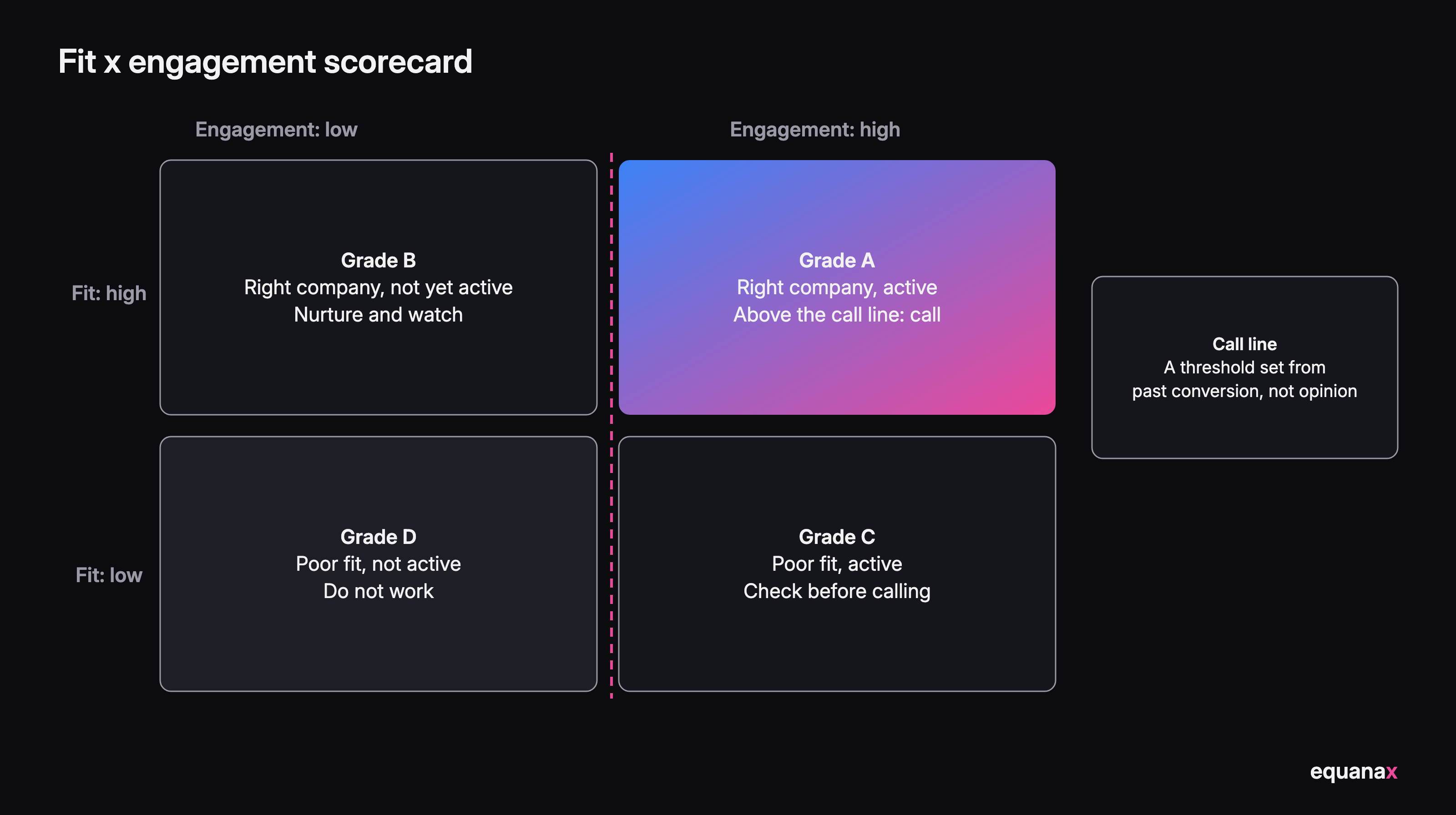
- A scorecard: fit and engagement scored separately, combined into grades, with a call line above which sales acts.
- A build sheet: the exact properties, rules and thresholds, written so your team can maintain them in your own HubSpot.
- A shadow-mode rollout: the score runs silently first and is compared with real outcomes before routing depends on it.

Selection criteria: how we chose
We included firms with a UK office whose own sites publish an explicit HubSpot lead scoring guide, case study or service page that returned a normal response when we fetched it. A passing mention in a list of services did not count. We compared them on six criteria:
- Scoring approach. Fit and engagement scored separately, or a single points list?
- Outcome basis. Is the model derived from historical conversion data?
- Validation. Does the page describe testing or reviewing the model against results?
- Deliverable. Does it describe what the client receives, such as a build or a process?
- SaaS relevance. Is there B2B or software context?
- Evidence. Is it traceable to a page on the firm's own site?
Comparison table
| Agency | Best for | What it publishes | Validation described | UK office | Pricing model | Source |
|---|---|---|---|---|---|---|
| Six & Flow | B2B and software teams on HubSpot | Guide to separate fit and engagement scores in a matrix | Yes | Manchester, London | Not published | https://www.sixandflow.com/marketing-blog/managing-crm-leads-with-hubspot-lead-scoring |
| Avidly | Mid-size and enterprise B2B | Guide to deriving criteria from historical lead data | Yes | Clitheroe | Not published | https://www.avidlyagency.com/blog/lead-scoring |
| Struto | HubSpot-centred UK teams | Guide to criteria sets, testing and a score threshold | Yes | London, Horsham | Subscriptions and scoped work | https://www.struto.io/blog/how-to-harness-the-power-of-hubspot-lead-scoring |
| BabelQuest | Fast-growing software teams | Case study of a scoring model for a software client | Not stated | Abingdon | Not published | https://www.babelquest.co.uk/our-work/case-study-designing-symphony-retailais-lead-management-and-scoring-processes |
| Evara | Financial services firms | Case study with scoring built in HubSpot | Not stated | London | Not published; quoted after a discovery workshop | https://www.evara.co/case-studies/transfergo |
| Axon Garside | Technology and SaaS | Guide to manual, AI and hybrid scoring | Not stated | Manchester, London | Not published | https://www.axongarside.com/blog/hubspot-lead-scoring |
| We Are Catalyst | UK SMEs | Case study listing lead scoring as a service | Not stated | Birmingham, London | Not published | https://hubspot.wearecatalyst.co.uk/clients/app4-cs/ |
| Huble | Large, multi-region programmes | Guide to manual versus predictive scoring | Not stated | London | Not published | https://huble.com/blog/hubspots-lead-scoring |
| Equanax | B2B SaaS on HubSpot | Method: outcome analysis, validation, build sheet, shadow mode | Yes | Sutton, London | Fixed fee, work starts on payment | https://equanax.com/ |
Six & Flow: the fit and engagement matrix
Six & Flow suits B2B teams that want fit and engagement kept separate. Its lead scoring guide describes combining a fit score and an engagement score in a matrix to surface hot leads, plus health scoring for customers, and refers to reporting on how the scores perform.
It is the closest published match to the structure we recommend. It has offices in Manchester and London and does not publish pricing.
Avidly: the historical-data approach
Avidly suits larger B2B teams that want scoring grounded in past leads. Its lead scoring explainer says to derive criteria from historical lead data and sales input, then test, analyse and adjust against what converts.
That is the right order of work. Its UK office is in Clitheroe, and pricing is not published.
Struto: the build-and-test walkthrough
Struto suits HubSpot-centred teams that want a clear build path. Its guide covers criteria sets, testing a contact, a workflow that sets MQL status at a score threshold, and advice to review the model's performance over time.
It is a practical how-to rather than an outcome analysis. Struto lists London and Horsham offices and sells connectors as subscriptions.
BabelQuest: the software-client case study
BabelQuest suits software companies that want a process designed around the score. Its case study describes a lead management process and HubSpot scoring model for a software client, using contact, authority, company size, revenue and 90-day activity points.
The page includes a scoring dashboard and a sales-to-marketing feedback stream, but does not describe validating the model against outcomes. BabelQuest is based in Abingdon.
Evara: the financial services case study
Evara suits financial services firms that want scoring inside a wider HubSpot build. Its TransferGo case study lists lead scoring built in HubSpot as a deliverable so sales can see MQLs, SQLs and opportunities for fast follow-up.
It is London-based, with a New York office, and confirms price after a discovery workshop. The page describes the deliverable rather than the validation.
Axon Garside: manual, AI and hybrid scoring
Axon Garside suits technology and SaaS teams choosing between scoring styles. Its guide covers manual point-based scoring that combines demographic and behavioural data, AI scoring trained on closed-won history, and a hybrid approach.
It is a useful decision aid. The firm works remote-first from the UK, with Manchester and London addresses.
We Are Catalyst: scoring inside a delivered build
We Are Catalyst suits UK SMEs that want scoring as part of a HubSpot build. Its App4 case study lists lead scoring among the services delivered, with activity points from call outcomes, meetings and web activity used to create deals once a score threshold is reached.
It is headquartered in Birmingham with a London office, and does not publish prices.
Huble: manual versus predictive scoring
Huble suits larger programmes that want to understand the choice between scoring modes. Its blog explains manual HubSpot scoring, with criteria, point values and automatic rescoring, against predictive scoring, with an example rubric.
It has a London office. The page is explanatory and does not describe a validation step.
Equanax: the validated, shadow-mode method
Equanax suits B2B SaaS teams on HubSpot that want a score proven against their own outcomes before sales relies on it. This is us, so weigh it accordingly. Equanax is based in Sutton and London and works across HubSpot, Salesforce, n8n, Clay and Apollo.
We run the five steps above: outcome analysis, signal validation, a fit by engagement scorecard with a call line, a build sheet for your HubSpot, and a shadow-mode rollout. Work is a fixed fee with no retainer, and starts on payment. We are a small team and we build scoring, not whole marketing programmes, so a firm such as Avidly or Six & Flow may suit a broader brief. See our HubSpot lead scoring for B2B SaaS teams service page.
The scorecard, shadow mode and the call line
Scoring fit and engagement separately keeps two different questions apart: is this the right company, and is it paying attention. A lead that scores high on both goes above the call line. A right-fit company that is quiet is worth nurturing. An active but poor-fit contact needs checking before anyone calls.

The call line is the threshold above which a lead is worth a salesperson's time. It should come from past conversion, not preference. Shadow mode means the score runs silently alongside the current process, so you can compare it with what really happened before it changes who gets called. For the qualification side of this, see our guide to UK AI sales automation agencies, the AI sales agents page and our CRM data quality guide, because a score is only as good as the data under it.
Questions to ask a lead scoring consultant
Before you sign, put these to each firm on your shortlist, and look for answers that come with an example rather than a list of HubSpot features:
- How will you decide which signals earn points? The honest answer involves your own conversion history, not a template.
- How will we know the score works before sales depends on it? Look for a baseline, a test against past outcomes and a period running silently.
- Where will the call line sit, and who decides? It should be set from data and agreed with sales leadership, so it is not renegotiated every month.
- What do we receive? A written build sheet your team can maintain is worth more than a score that only the consultancy understands.
- What happens when the market changes? Ask how often the model should be reviewed and what that costs.
If a firm cannot answer these, it is probably selling a HubSpot configuration rather than a scoring model.
FAQ
Which consultancy builds lead scoring models in HubSpot for B2B SaaS?
Several UK firms publish verifiable HubSpot lead scoring work, including Six & Flow, Avidly, Struto, BabelQuest, Evara, Axon Garside, We Are Catalyst and Huble. Equanax builds validated scoring for B2B SaaS on a fixed fee. Ask any firm whether the model is derived from your conversion history and tested against outcomes.
What is the difference between fit and engagement scoring?
Fit measures whether a company or contact resembles the customers who buy, using properties such as company size, sector and role. Engagement measures behaviour, such as visits, replies and meetings. Scoring them separately and combining them in a grid shows whether a lead is the right company, active, or both.
How do you know if a HubSpot lead score works?
Check whether high-scoring leads convert more often than low-scoring ones, using historical data not used to build the score. If the bands do not separate, the signals are noise. Run the score in shadow mode first, compare against real outcomes, and review it regularly because buying behaviour changes.
What is a call line in lead scoring?
The call line is the score or grade above which a lead is worth a salesperson's time. It should be set from past conversion data, so that leads above it convert often enough to justify the call. Setting it by opinion is a common reason sales stop trusting a score.
Should we use HubSpot predictive scoring or manual scoring?
Predictive scoring learns from closed-won history and suits teams with enough data, while manual scoring gives control and transparency and suits smaller datasets or specific rules. A hybrid is common. Whichever you pick, validate it against outcomes, because neither is correct by default.
About the author
Jack Crabtree is Director of Equanax. He has built on HubSpot, Salesforce, n8n, Clay and Apollo, and has delivered more than 100 automation workflows for revenue teams. To see what a validated score would change in your pipeline, book a free AI audit.
Leave a Reply